

Telegram has announced plans to introduce a native, non-custodial Gram wallet to more than 1 billion monthly users this summer, enabling instant cryptocurrency transfers without fees.
Summary
- Telegram plans to launch a fee-free, non-custodial Gram wallet for over 1 billion users.
- Pavel Durov called it the largest self-custody wallet rollout ever attempted.
- The wallet deepens Telegram’s TON integration following Toncoin’s rebrand to Gram.
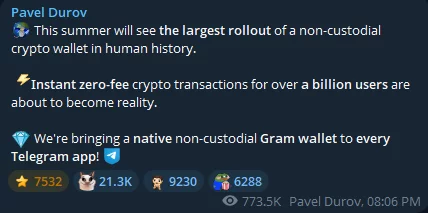
Pavel Durov, writing on Telegram on Wednesday, described the planned integration as the “largest rollout of a non-custodial crypto wallet in human history.” The Telegram founder did not provide a fixed release date, list supported assets, or explain how the app would cover network costs while offering fee-free transfers.
Unlike a custodial service, the proposed wallet would let users control their crypto rather than leaving their assets with Telegram or another company. Durov’s announcement places the feature directly inside the messaging app, removing the need for users to download a separate wallet before sending funds to their contacts.
Telegram reported more than 1 billion monthly active users in 2025, giving the Gram wallet access to an audience few standalone crypto products can match. While Durov did not publish an adoption target, the company’s user count means even a small uptake could introduce millions of people to self-custody and peer-to-peer crypto transfers.
Exact launch conditions remain unclear because Telegram has not explained whether the wallet will become available worldwide at once or arrive through a phased release. The company has also not disclosed its recovery system, security safeguards, regional restrictions, or whether users will need to complete identity checks for certain services.
Gram wallet places distribution at the center of TON adoption
Telegram’s announcement follows The Open Network’s decision to rename its native Toncoin token as Gram, restoring the name used in Telegram’s original 2018 blockchain white paper. Durov presented the change as a return to the project’s early identity, while TON has stated that the blockchain itself will retain The Open Network name.
According to reporting from crypto.news, the token transition was scheduled to take about three weeks and did not require holders to swap their existing coins. The publication reported that Gram climbed as much as 19% after Durov disclosed the change, reaching $2.21 as traders reacted to Telegram’s renewed involvement.
Gram’s return carries regulatory history because Telegram previously used the name for the token attached to its first blockchain project. After Telegram raised $1.7 billion from investors, the US Securities and Exchange Commission sued the company in 2019 and alleged that its planned token distribution involved unregistered securities.
Under a 2020 settlement cited by the SEC, Telegram agreed to return more than $1.2 billion to investors and pay an $18.5 million civil penalty. Telegram then withdrew from the project, while independent developers continued the open-source code that eventually became the present TON network.
Since leaving the original project, Telegram has gradually brought TON-based services into its app. The Financial Times reported that Telegram advertising can be purchased with the network’s token, while creators can receive crypto payments and developers can build games, stores, and other services tied to TON.
Durov has also promoted investment in the network. He reported in 2025 that venture capital firms had invested more than $400 million in Toncoin, naming groups including Sequoia Capital, Benchmark, Ribbit Capital, Draper Associates, and Vy Capital.
TON is extending wallet control to automated Telegram services
TON’s payment plans have expanded beyond person-to-person transfers through an Agentic Wallets standard introduced by TON Tech on April 28. As crypto.news reported in May, the system allows AI agents operating through Telegram bots to control user-funded wallets and carry out limited financial actions.
TON Tech described the products as “self-custody wallets designed for autonomous AI agents on TON.” Under its documentation, a user funds an agent’s separate on-chain wallet and grants permission to perform selected tasks, including transfers, token swaps, and interactions with decentralized finance applications.
Control remains tied to the user’s main wallet, according to TON Tech, which allows the owner to set a spending budget, withdraw the remaining balance, or cancel the agent’s access. The infrastructure team said no intermediary holds the funds and existing TON wallets do not require an upgrade because the design uses a standard smart-contract structure.
Agentic Wallets and the planned Gram wallet serve different functions, but TON Tech’s April release shows how the network is building payment tools for both people and automated services inside Telegram. The main Gram wallet would give users direct control over routine transfers, while the agent standard assigns limited permissions to bots without handing them master keys.
Telegram has yet to disclose whether the summer wallet will connect directly with Agentic Wallets or other TON-based products. Until the company publishes technical documentation and rollout terms, Durov’s announcement establishes the intended scale and fee model but leaves the wallet’s security, availability, and complete feature set unresolved.