

Prediction markets are lowering the chances of the CLARITY Act becoming law in 2026 as the Senate turns to Russia sanctions and federal nominations before its August recess.
Summary
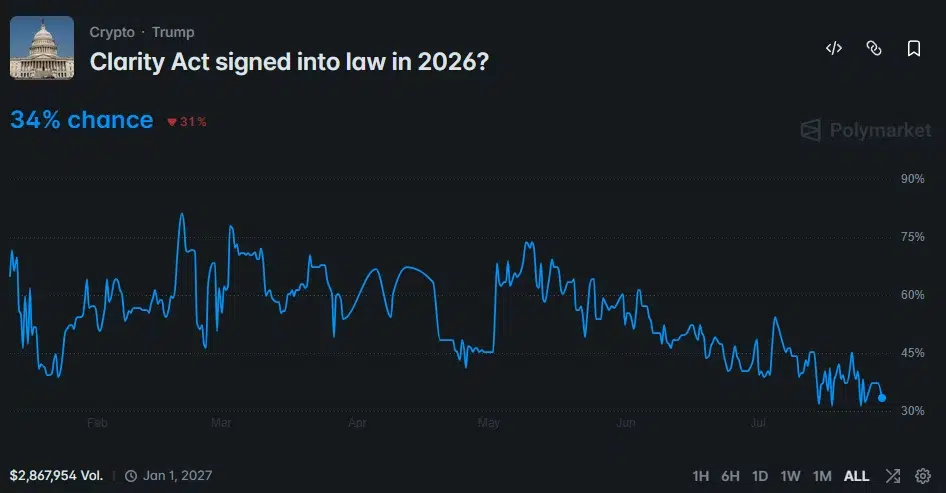
- Polymarket traders place the bill’s 2026 passage odds at about 34%, down from 53% on July 21.
- Galaxy Digital’s Alex Thorn estimates a 30% chance of passage, citing vote math and limited floor time.
- Republicans may need support from at least 10 Democrats if three GOP senators remain unavailable or opposed.
- Bitcoin traded near $63,800 as regulatory uncertainty added to broader pressure across crypto markets.
CLARITY Act loses its place on the Senate schedule
Senate Majority Leader John Thune has not scheduled immediate action on the CLARITY Act, narrowing the path for the crypto market structure bill before lawmakers leave Washington.
The Senate is instead moving forward with federal nominations and legislation imposing sanctions on Russia and Iran. Preliminary action on the crypto bill remains possible during the week of Aug. 3, but the chamber is scheduled to begin its summer recess after Aug. 7.
According to Galaxy Digital head of research Alex Thorn, the timetable has become the main threat to passage.
“The calendar is no longer merely an obstacle. It is now the enemy.”
Thorn estimated that lawmakers needed to begin the floor process by July 30 to leave enough time for procedural votes and debate. The Senate’s decision to prioritize other legislation makes that timeline increasingly difficult.
A vote after the recess is still possible. However, senators would return closer to the November midterm elections, when campaigning could displace complicated legislation requiring bipartisan negotiations.
Senate vote math leaves little room for defections
Most legislation needs 60 votes to overcome the Senate filibuster, while Republicans control 53 seats.
Thorn argues that the bill’s effective Republican support may be closer to 50. Senators Josh Hawley and Rand Paul have not committed to voting for the measure, while Mitch McConnell’s hospitalization could prevent him from participating.
Under that scenario, Republicans would need 10 Democratic votes to advance the bill.
The Senate Banking Committee approved its version of the CLARITY Act in May by a 15-9 vote, with two Democrats joining Republicans. Both Democratic supporters warned that their committee votes did not guarantee backing on the floor without further changes, particularly to ethics provisions governing public officials’ crypto interests.
President Donald Trump later accepted the inclusion of ethics restrictions, helping Polymarket odds reach 53% on July 21. Those gains have since reversed, with the market showing roughly 34% odds at the time of publication.
Kalshi showed traders assigning a 42% probability to crypto market structure legislation becoming law before the end of 2026.
Trump ties deepen the partisan divide
SkyBridge Capital founder Anthony Scaramucci said Democratic opposition may persist because Trump has made the bill part of his political agenda.
“They will do everything they can to block it because he wants it,” Scaramucci said.
Cardano founder Charles Hoskinson has made a similar argument, warning that the “Trump narrative” has turned crypto regulation into a partisan dispute.
Democrats have raised concerns about the adequacy of the proposed ethics rules, citing Trump’s family-linked crypto activities. They have also sought stronger consumer protections, enforcement powers and restrictions covering officials’ indirect financial interests.
Republicans have made several concessions to attract Democratic votes, but the revised language has not produced enough public commitments to clear the 60-vote threshold. The bill would also return to the House if the Senate approves a materially different version, adding another step before it could reach Trump’s desk.
Bitcoin slips as US regulatory uncertainty continues
Bitcoin traded near $63,800 at the time of publication, down about 1.6% over the previous session after moving between roughly $62,772 and $64,953.
The decline coincided with the Senate delay, though the timing alone does not establish that the CLARITY Act caused the broader market pullback. Macro conditions, derivatives positioning and weaker demand can also affect daily price movements.
US spot Bitcoin ETFs recorded $11.64 million in net outflows on July 27, led by an $8.82 million withdrawal from BlackRock’s IBIT. Ether funds attracted $9.23 million, while XRP ETFs added about $592,000.
For US investors, another delay would preserve the existing mix of SEC and CFTC oversight, court decisions and state-level rules instead of creating a single federal market structure. The bill is not dead, but failure to begin the Senate process before the August recess would leave its 2026 prospects dependent on a narrower post-election legislative window.