

Aster CEO Leonard Leung has launched an investigation into unusual ASTER price movements after the cryptocurrency briefly surged above $0.71 before losing more than 32% of its value within minutes.
Summary
- ASTER price fell 32.5% from $0.7124 to $0.4812 following a brief rally during November 16 trading.
- Aster CEO Leonard Leung attributed the unusual volatility to liquidations involving highly leveraged positions.
- Leonard said the activity was potentially malicious but maintained that Aster had no ASTER market-making arrangements.
- ASTER recovered to $0.5456, gaining 4.32% over 24 hours despite its weekly and monthly losses.
- Aster plans to publish further investigation findings, while its existing token buyback and reserve-burning program continues.
In a Monday post on X, Leonard attributed the volatility to liquidations involving highly leveraged trading positions, which he described as “likely malicious.” He said the team was investigating the incident, while maintaining that the price movements had nothing to do with ASTER market-making arrangements.
Meanwhile, the token climbed to $0.7124 before falling to nearly $0.4812, a peak-to-trough decline of 32.5%. The fall followed a brief rally of nearly 30% within an hour, leaving traders dealing with considerable price movements in both directions.
Aster CEO Investigates Suspected Malicious Liquidations
Leonard acknowledged the unusual trading activity and said the platform was working to establish what had happened. In his statement, he wrote, “The price volatility is a result of liquidations of highly leveraged positions, likely malicious.”
His explanation pointed to forced closures of leveraged positions, although the investigation has not yet established whether traders deliberately caused those liquidations or who may have been involved.
In a separate statement, Leonard sought to reassure users about the exchange’s operations.
“Aster is running business as usual,” he wrote, rejecting suggestions that the volatility resulted from market-making activity involving the token.
“We do not have any such arrangement with any market makers,” he added.
The CEO’s statements addressed concerns about the token’s trading activity and the platform’s operations. However, Aster has not publicly identified the positions involved or disclosed how much traders lost during the episode.
Leonard said the company would share further details in subsequent reports, without providing a publication date.
How Leveraged Liquidations Can Trigger ASTER Price Swings
Aster operates a decentralized exchange offering perpetual futures, allowing traders to open leveraged positions without a fixed expiration date. Such positions can be closed automatically when market movements leave traders with insufficient collateral.
According to Aster’s liquidation documentation, the platform uses a mark price derived from funding information and prices across several spot exchanges to determine when positions must be liquidated.
When an account’s remaining margin falls below its maintenance requirement, the exchange begins closing the position. Its rules explain that positions may be transferred to an insurance fund at their bankruptcy price, with the fund covering certain losses when account balances turn negative.
The insurance fund forms part of Aster’s risk-management system. However, Leonard’s statements did not specify whether the latest liquidations caused losses to the fund or identify the contracts involved.
The exchange has previously handled considerable trading activity during market selloffs. In February, crypto.news reported substantial derivatives trading across decentralized perpetual exchanges, with Aster processing $11.55 billion during a single 24-hour period. That figure represented trading volume, not liquidation losses.
Subsequently, Aster introduced new perpetual listing rules in August, requiring applicants to stake 1 million ASTER for four years before their proposed markets could receive approval. Under those rules, the platform’s risk team retains responsibility for leverage limits and contract settings.
ASTER Price Recovers Above $0.54 but Remains Under Pressure
Despite the rapid decline, ASTER recovered part of its losses during Monday’s session. According to crypto.news market data, the token traded at $0.5456 at press time, up 4.32% over the previous 24 hours.
The daily gain contrasts with its performance over longer periods. ASTER remained down 14.9% over seven days and 22.67% over the past month, with nearly $362.8 million in daily trading volume.
Its market capitalization stood near $1.40 billion, with 2.57 billion tokens circulating. ASTER was still trading more than 77% below its September 2025 record high of $2.41.
Technical indicators continued to show weakness. The token remained below its 20-day simple moving average of $0.6548, while the Stochastic RSI stood at 18.02, beneath its signal line of 26.66.
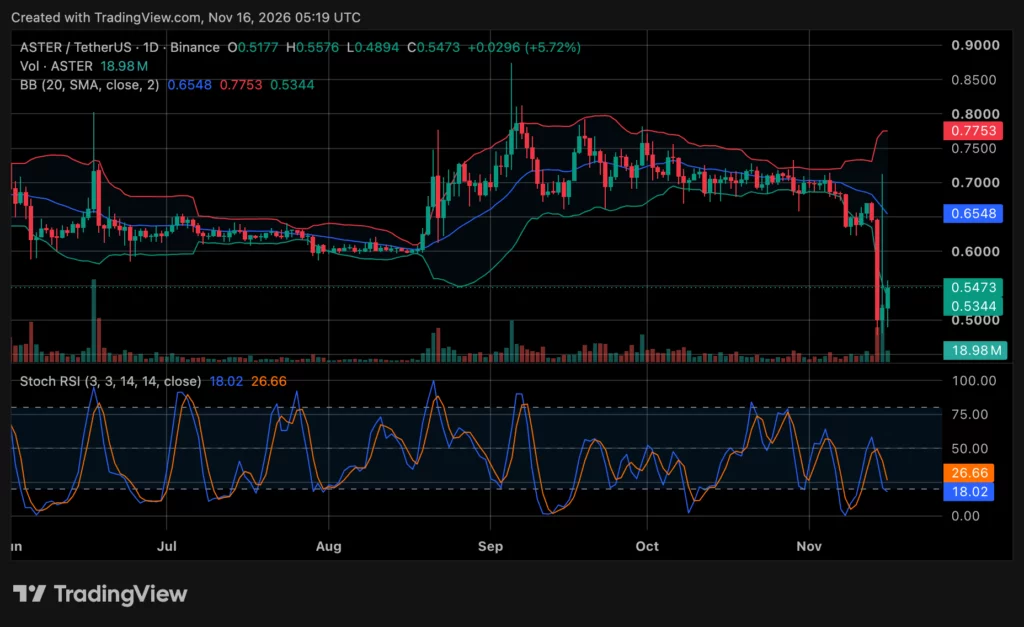
Immediate resistance sits near $0.56, followed by $0.60. On the downside, the $0.53 area provides nearby support, while a return toward $0.49 would bring the latest trading low back into focus.
Aster’s Token Buyback Program Remains in Place
The investigation follows several changes to Aster’s token structure during 2026. In June, the exchange introduced a revised buyback program directing 99% of daily platform fees toward purchasing ASTER.
Under the arrangement, repurchased tokens are distributed to veASTER stakers, while an equivalent number of tokens is burned from reserves. The program is intended to reduce the token’s total supply from 8 billion to 3 billion over time.
Aster’s October 19–November 2 update showed that the exchange bought back approximately 2.60 million ASTER and burned an equivalent amount from its team allocation.
The program continues under the exchange’s published tokenomics rules, which specify that reserve burns occur every two weeks and begin with the team allocation.
Disclosure: This article does not represent investment advice. The content and materials featured on this page are for educational purposes only.