

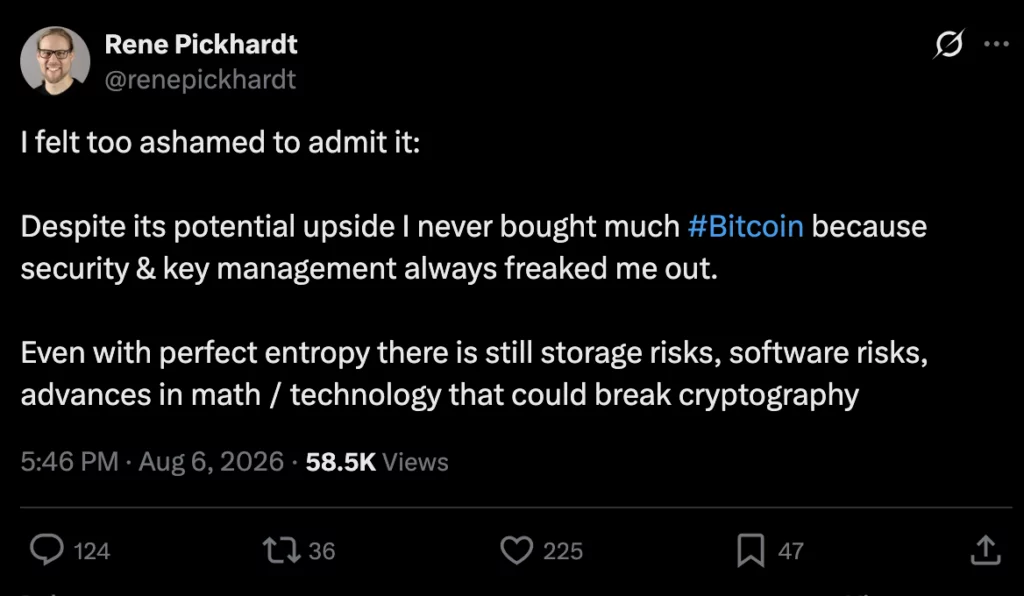
German Bitcoin developer René Pickhardt said on Aug. 6 that fears about self-custody security and key management kept him from accumulating more Bitcoin, despite believing the asset had upside.
Summary
- Bitcoin developer René Pickhardt says self-custody security concerns kept him from accumulating more BTC earlier.
- Coldcard vulnerabilities made some wallet seed phrases predictable, exposing users to remote key recovery attacks.
- Galaxy Research estimates roughly 1,755 BTC was stolen across several waves linked to vulnerable wallets.
- Coinkite says patched firmware cannot repair previously generated weak seeds, requiring users to migrate funds.
- Adam Back argues Bitcoin self-custody remains powerful but requires users to accept greater security responsibility.
In a post, Pickhardt wrote that “security & key management always freaked me out,” framing his decision as a risk-management choice rather than a criticism of Bitcoin.
His remarks landed after the Coldcard hardware-wallet incident renewed scrutiny of how self-custody tools generate private keys. Security research linked vulnerable Coldcard firmware to predictable seed generation, while on-chain analysis cited by Galaxy Research estimated roughly 1,755 BTC had been stolen across several attack waves. The loss total remains under investigation.
Coldcard failure puts Bitcoin key generation under scrutiny
The Coldcard issue involved randomness used when generating wallet seeds, not a failure of the Bitcoin protocol. Block’s Bitcoin security researchers found that certain firmware configurations could bypass hardware randomness and fall back to weaker software-generated entropy. That reduced the unpredictability of some seed phrases and potentially allowed attackers to reconstruct private keys without physically possessing the device.
Coinkite acknowledged the firmware problem and released patched software. However, the company warned that installing new firmware does not repair a seed created under vulnerable conditions. Users with affected seeds must generate a new one securely and move funds on-chain. Reports citing Galaxy Research put one July 30 theft wave above 1,000 BTC, with subsequent attacks lifting estimated losses.
The episode illustrates the distinction explained in our self-custody guide: controlling private keys removes exchange counterparty risk, but transfers responsibility for key generation, backup and recovery to the owner. Hardware wallets reduce online attack surfaces, yet depend on firmware, hardware design and secure randomness.
Pickhardt says security concerns outweighed Bitcoin upside
Pickhardt has worked extensively on Lightning Network routing and payment reliability, and Bitcoin Optech identifies him as a Lightning developer and researcher with OpenSats. His 2026 paper includes a mathematical framework for payment-channel networks focused on liquidity and off-chain throughput.
Against that background, his admission drew attention because technical familiarity did not eliminate his custody concerns. Pickhardt said even correctly generated private keys face risks involving storage, implementation mistakes and future advances in computing. Those concerns do not mean properly implemented self-custody is inherently unsafe; they describe the operational burden individual holders accept.
Blockstream CEO Adam Back responded that “with great bearer cash power comes great responsibility to not lose your keys.” The response captures the trade-off: Bitcoin allows holders to control assets without a bank, but no central institution can reset a lost private key or reverse an unauthorized valid transaction.
Coldcard losses sharpen the self-custody debate
Recent wallet security incidents give that debate context. Cinco Días, citing Galaxy Research, reported that roughly 1,755 BTC had been stolen from about 5,000 wallets across several waves. Earlier Galaxy estimates were lower, and Coinkite has said the full attribution and scope remain unresolved, so the figure should be treated as an evolving on-chain estimate rather than a final confirmed loss.
The failure also does not show that every hardware wallet faces the same flaw. Block said its products were unaffected, while other manufacturers have separately explained their entropy-generation designs. The vulnerability followed affected seed phrases even if users imported them into another wallet, meaning changing hardware without creating new keys would not remove the underlying exposure.
Our seed phrase security guide explains why the recovery phrase is effectively the master key to a wallet. If generation is weak, offline storage cannot restore the missing entropy afterward. The Coldcard case therefore shifts attention from simply hiding a seed toward verifying how securely it was created.
What Bitcoin holders should watch next
Coinkite’s investigation, blockchain tracing and any law-enforcement findings will determine the final scale of the Coldcard losses. Users who created seeds on affected firmware should follow the manufacturer’s remediation guidance rather than assume a firmware update alone fixes an existing wallet.
For the broader Bitcoin market, Pickhardt’s comments are anecdotal and do not establish that self-custody fears are suppressing adoption. Still, the episode shows why usability and security remain linked. As hardware wallets become easier to buy, manufacturers face pressure to make key management both verifiable and understandable.
Pickhardt’s decision shows that conviction in Bitcoin’s monetary thesis does not automatically translate into comfort with bearer-asset security. Self-custody removes one class of intermediary risk while creating another set of responsibilities. The Coldcard failure has made that trade-off harder to dismiss, especially for holders deciding whether direct ownership outweighs the operational burden of securing keys themselves.