

Key Takeaways
- Probing suspicious Polymarket bets, James Comer’s investigation forces platforms to show their safeguards against insider trading.
- Sparked by proven insider trading moves, the probe exposes market risks and will likely drive new rules.
- After Gannon Ken Van Dyke made $400K, Congress will next use this probe to draft prediction market laws.
Rep. James Comer Launches Probe On Insider Trading Happening On Prediction Markets
Kentucky Rep. James Comer announced the launch of a probe to assess the measures that prediction market platforms are taking to fight insider trading.
Comer, who chairs the House Committee on Oversight and Government Reform, sent letters to Polymarket CEO Shayne Coplan and Kalshi CEO Tarek Mansour requesting a series of documents to verify the measures these platforms are taking against these processes, their internal discussion on the subject, and the different know-your-customer (KYC) measures these platforms are implementing.
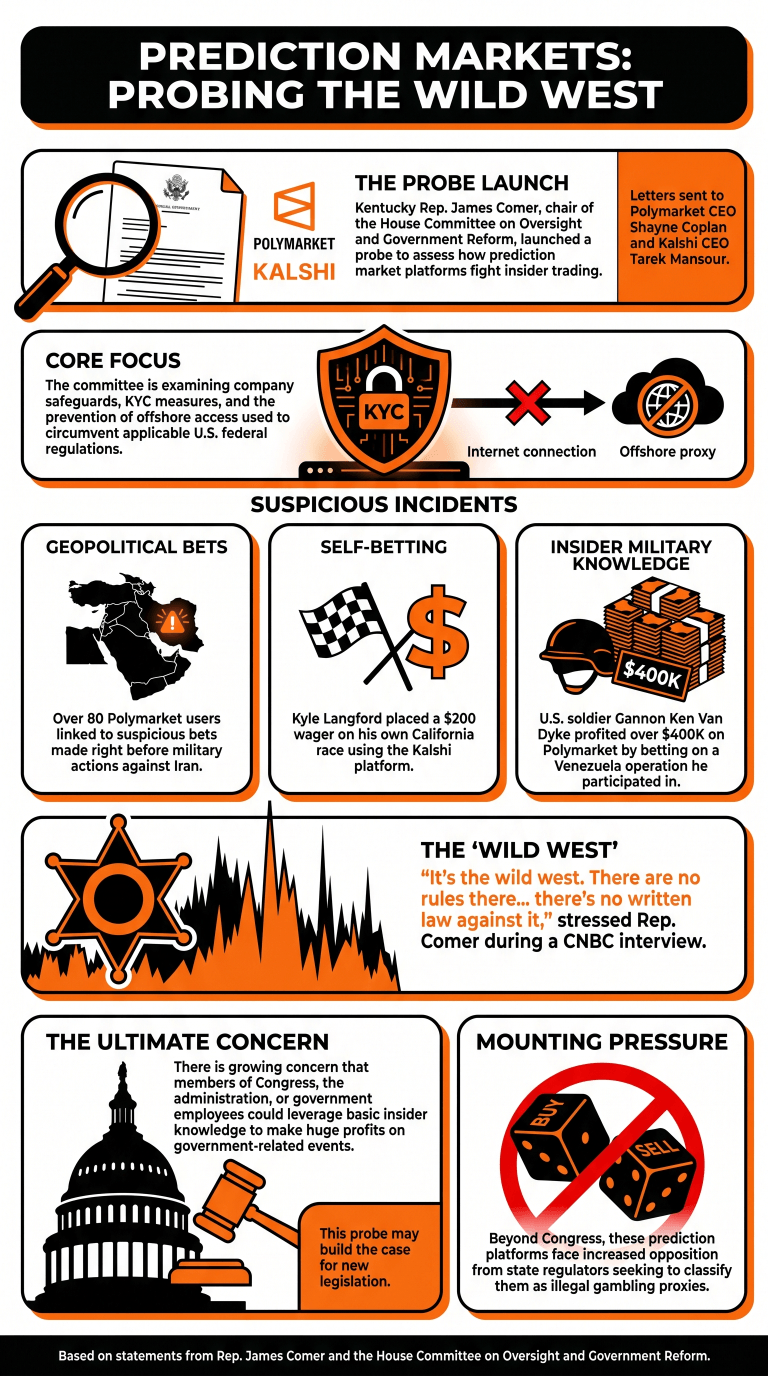
Comer stated that the committee was “examining the adequacy of company safeguards to prevent access to offshore sites to circumvent compliance with applicable U.S. federal regulations governing prediction market platforms.”
The probe follows a series of reports linking over 80 Polymarket users to insider trading after “suspiciously timed bets” before military actions were taken against Iran, and Kyle Langford’s $200 wager on his own California race using Kalshi.
During a recent interview on CNBC, Comer stressed the need for regulations in the prediction market space, calling it the “Wild West.”
“It’s the wild west. There are no rules there. You know, you and I may think we know what’s ethical and what’s not, but there’s no written law against it,” he declared.
Comer also pointed out the insider trading situation involving Gannon Ken Van Dyke, a U.S. soldier who participated in the operation against Venezuela’s Nicolas Maduro and profited over $400K from his personal bets on Polymarket, as a wake-up call.
“There’s a concern now that members of Congress, members of the president’s administration, or any type of government employee could use basic insider knowledge and make huge profits on anything government-related,” Comer declared, stressing that this upcoming probe might be used to prove the case for legislation to rein in this activity.
The investigation puts prediction platforms under pressure from Congress, as they also face increased opposition from state regulators who seek to classify them as gambling proxies.